
If we want to be taken seriously as bloggers, we must take blogging seriously.
I wrote that when I began If Emily Posted, when I found myself overwhelmed by the Wild West behavior online. Almost a year and a half after I began writing IEP, I still believe my initial hypothesis to be true:
Most bloggers want to do the right thing. Sometimes they simply need it defined.
I know I sound like a broken record at times, but most bloggers are running a solo show as writer, editor, photographer, publicist and agent. Most haven’t received a formal education in any of these areas. Especially the business end. (Hence the number of bloggers willing to do free PR, but that’s a post for another time.)
FACT: If you’re attempting to make a business out of blogging, or already are, you need to understand the FTC guidelines that concern bloggers who are monetizing their sites.
The guidelines are not new, but the March 2013 updates are important. We as bloggers, as professionals, need to keep up with this evolution. This homework is our responsibility. *
Attorney Sara Hawkins has written a wonderful breakdown of the FTC guidelines as part of her Blog Law series, and Blog With Integrity co-founder Susan Getgood wrote another great overview at BlogHer. The FTC booklet, which you can download for free, is good information to have on hand.
But I want to talk about what’s missing from the guidelines that many bloggers need.
You won’t find a section within the pages of that PDF that calms the fear that the word disclosure brings to many bloggers. A section that tells them not to be afraid of reader backlash for what can be an anxiety-provoking issue. (My friend Maegan wrote from the heart yesterday about misconceptions about paid content, and its strain on the blogger/reader relationship.)
Fear that readers will boycott keeps many bloggers from making disclosure obvious. They hide it in the fine print at the footer of their website or on their disclosure policy page or maybe they don’t say anything at all. Because they’re afraid of disappointing readers. It’s why bloggers post links to products in their posts or on their Facebook pages without disclosing “by the way, when you click this link it helps me make a living.”
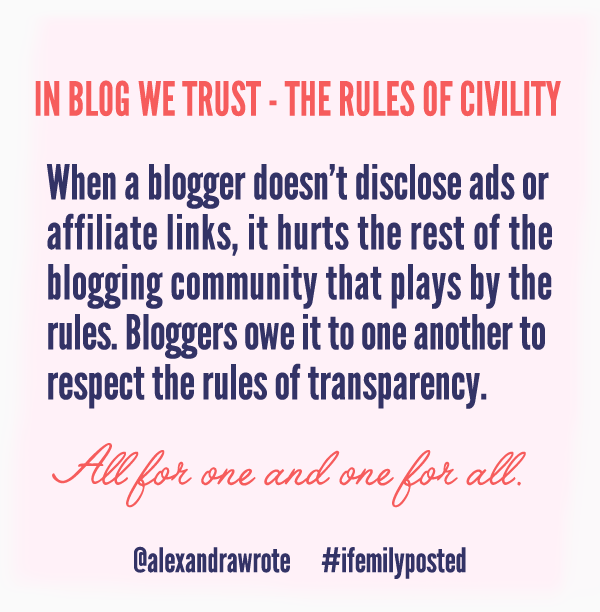
FACT: When a blogger doesn’t disclose ads ethically, it hurts the rest of the blogging community that is playing by the rules. It promotes the notion that there’s something shameful in making a living this way.
IEP is primarily about social media netiquette and ethics for bloggers, but social media is a two-way street of content creators and content consumers. Sometimes readers need things defined, too.
Readers of the blogosphere, trust in the hardworking bloggers who create the content that inspires, entertains and informs you. Understand that your approval is taken very seriously. Also understand the hours, the days, the weeks, that can go into creating that content. (Paid or unpaid.)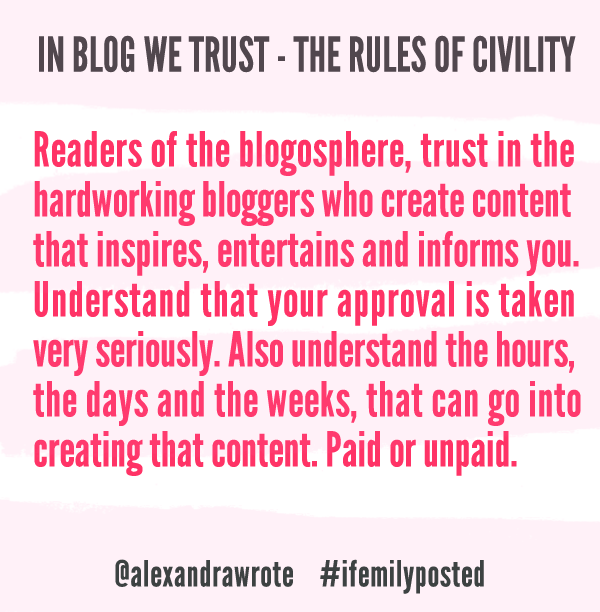
The new rules quite clearly tell bloggers to simplify disclosure. Make it clear. State it upfront and in each post where it applies.
FACT: For a long time, I place disclosure at the bottom of posts. I thought that was right. I was wrong.
If someone clicked through to check out a book I talked about before reading the affiliate links disclosure at end of my post, they’d have no idea. That’s why it needs to be the first thing they see, not the last.
It’s OK to make mistakes. The good news is this is all very fixable.
RULE: Don’t try to hide disclosure or bury it in fine print. Bring it to the top of your post and make it easy to read.
Bloggers owe it to one another to respect the rules. As I wrote in March of last year:
History has shown us that civilization can’t sustain itself if it isn’t, well, civilized.
Here’s to the rules of civility.

I saw your disclosure on your other post, and I loved it. Could you take a look at mine and let me know what you think? I would love to get your advice on whether or not I should change something. (http://www.masterofmom.com/p/let-me-disclose-to-you.html)
Thanks!