
Monthly Archives: August 2012

Social media was abuzz this week over news about people buying Twitter followers. I thought this was common knowledge, but from the reactions I saw, I realized many were unaware. I’m happy to see that it’s being acknowledged and discussed. Sure, followers can be bought, but at what cost?

Purchasing social media clout is a bit like taking a shortcut to win a marathon. The only victory, if you can call it that, is getting away with pretending to be better at something than you are.

Across the web, you can buy followers for Twitter, Facebook, YouTube and more. They’re relatively inexpensive. Forbes reported sites selling a thousand Twitter followers for $17, while last fall,this Inc. article broke down some eBay options.

So, what caused the breaking news and a flurry of tweets and Facebook posts this week? All it took was a free, web-based, third-party Twitter app to raise awareness about the need for social media quality control.
On Monday, Fast Company published a story about the StatusPeople Fakers app bringing a bit of what they called “Twitter shame” to social media. StatusPeople wanted to call out those who “buy followers in a vain attempt to build legitimacy.”

I saw a certain level of concern as people tweeted and posted, realizing that an app could possibly reveal numbers we trusted could, in fact, be wrong.

Fakers doesn’t tell you if someone has purchased followers, but it does reveal what percentage of followers one interacts with, how many are bots and how many accounts are inactive. You don’t have to sign up for an account; as a third party service you sign in with your Twitter account.

The app has some limitations, as the measurements are made from a sampling of 500 followers, but they state on their site that:

For those of you with 10,000 followers or less we believe our tool will provide a very accurate insight into how many inactive and fake followers you have.

If you’re very ‘popular’ the tool will still provide good insight but may better reflect your current follower activity rather than your whole follower base.

Apps that help you clean out your Twitter lists and eliminate followers who don’t interact are not new. This concept is somethign different. StatusPeople doesn’t want the Fakers to compromise Twitter integrity. They want users “to be able to spot them, and steer clear of them.” Whether people will change their behavior because they could face “Twitter shame” is yet to be seen.

Within 48 hours of the Fakers app taking Twitter by a storm came talk about changes at Klout. Changes in the algorithm by which they measure social influence were unveiled, causing some scores to rise and others to drop with positive and negative opinions shared accordingly.

We place so much value in numbers — followers, likes, stats, ranks, scores — without realizing how easily those numbers can be manipulated by purchasing followers or learning how to work the Klout system, as one Wired journalist wrote about in April.

When I spoke about Pinterest and leveraging social media at BlogHer ’12 in New York earlier this month, I couldn’t stress enough my belief that one’s social media value isn’t inherently based on numbers. That quality over quantity was important. Quality is harder to fabricate.

As a writer and as an editor, I am big on fact checking. I want to know where to get info and who are trusted sources.

If someone has tens of thousands of followers on Twitter, why do we so easily allow that number to validate them, without anything to support it? It’s an odd sort of hero worship, and it reminds me of the post Morgan of the818 wrote called Social Media Is a Warm Gun. An important reminder that people with big followings are not always reputable sources.

Social media does allow for Wild West behavior. People have the ability to present themselves as whatever they want to be. I doubt that, before the 21st century, so many people had bios and business cards that defined them as experts. But we trust this expertise based on…numbers.

Perhaps we need the option of using social media platforms without disclosing numbers. Before platforms like Twitter and Klout existed, back when blogs were stumbled upon in the literal sense, people read them because the content mattered to them. The quality was right there on digital paper.

Sometimes these numbers are a bit like going to the home of someone who has to tell you the how much everything costs. A painting isn’t any nicer because I know it cost three thousand dollars at auction. But knowing the number often makes us feel we are supposed to admire it for that reason, and not simply for what we like about it.
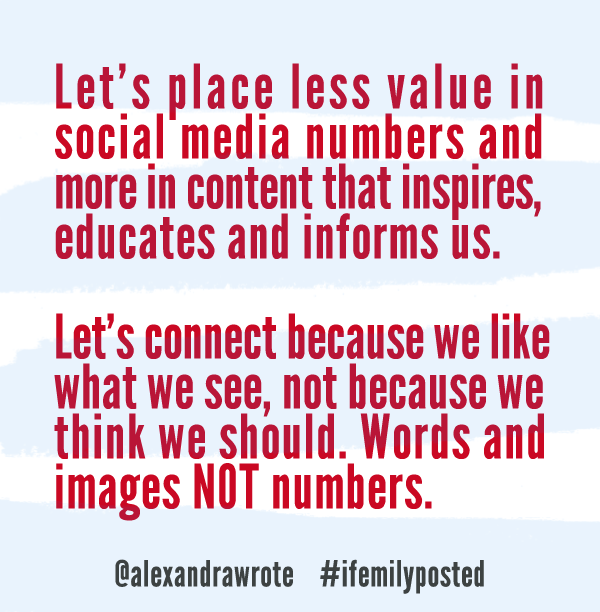
Let’s place less value in social media numbers and more in content that inspires, educates and informs us. Let’s connect because we like what we see, not because we’re think we should based on numeric value.

If StatusPeople’s Fakers app is the beginning of a shift toward transparency in social media, let’s find the silver lining here. There is a tremendous amount of talent online. If we, as bloggers, continue to produce the best work we can, than the opportunities that blogging brings will remain possible, regardless of the social media number du jour.
Pinterest info on the web generally falls into two camps: the how-to’s that encourage pinning with abandon and the anti-Pinterest campaigns that encourage people to boycott the site completely.

I don’t like those extremes. They lack opportunity for dialogue. Opportunity for education. Opportunity for change.

This time last weekend, I was looking over my notes for my BlogHer session and trying to condense everything I wanted to share into about 15 minutes. Inconceivable. Hopefully, I was able to lay a foundation for bloggers as to how they can use Pinterest and use it well.

What I aim for is a reasonable and well-informed middle ground: educating people as to how to use Pinterest well so that they can pin with un-reckless abandon, creating boards that respect online content.

Pinterest, like Tumblr or Facebook, or any other social sharing site, plays by the same rules. You can’t post what you don’t have the rights to.

In March, as I debated whether to continue using Pinterest, my concern was whether to keep using a platform that was hurting a lot of people by misattribution and IP theft. Here was the crux of the post:

If an elephant has its foot on the tail of a mouse, and you say that you are neutral, the mouse will not appreciate your neutrality. - Desmond Tutu

Rather than walk away, and say this is unfixable, I’d love the chance to try fixing it. I’m not good at quitting things when I know they could get better.

Looking away when someone is hurt and saying you don’t want to get involved is getting involved.

I decided to keep my boards. To believe that we, the users, the mighty mice, could make Pinterest better.

I think we can, and we are.

Once upon a time, I had almost a thousand pins. I hadn’t read the fine print. Many weren’t mine to pin in the first place. Others had old and broken links.

The value of your boards isn’t in the number of pins. Broken links aren’t valuable.

As I said at BlogHer, the great thing about Pinterest is that your ability to drive traffic isn’t inherently based on the number of followers you have. More followers mean more exposure, but the quality of a pin will lead to repins, which leads to more repins and more repins. Quality has the potential to create quantity.

Safety pinning: When is it pinnable?

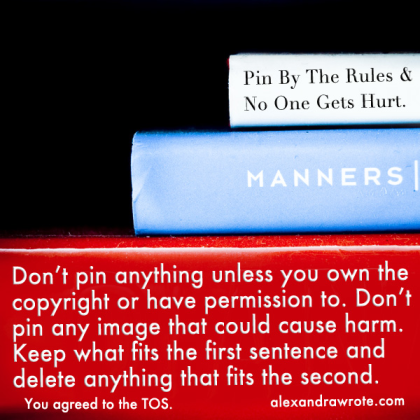
Pinterest controversy surrounds the issue of copyright - users agree in the TOS to only use images they own the copyright to or have permission to use.

As a writer and photographer, and in my editing work, I take this very seriously. As bloggers we should, too. No, not just as bloggers. Everyone should do it because it’s exactly what they agree to when they join Pinterest. And also, karma.

On a serious note, I know people who’ve had their livelihoods negatively impacted via improper pins. So pin with care because people need to put food on the table. That’s reason enough, isn’t it?

EVERYTHING YOU WANTED TO KNOW ABOUT PINNING SAFELY BUT WERE AFRAID TO ASK

The best part? It’s really easy.

- Pin your ORIGINAL site content. If you drew it, wrote it, photographed it - pin it.

- Pin from sites, from blogs to brand sites, with a visible Pin It button - be it embedded or via a Safety Pin. If they don’t clearly state “pin me” you can always email and ask someone. It’s fast and easy and people are generally awesome with a quick response. (Please offer the same respect to someone who says, “Please, pin away,” as someone who says, “Thanks, but not thanks.” One is no better than the other.)

- Before you repin, always be sure the link goes to the original source and it has the OK to be pinned in the first place (ex. curated content sites can include images that go to another site, or perhaps the right site but not the permalink for the post.)

- Pinning from a brand board? Only repin the content coming from their own sites. For example, a Martha Stewart board pin is safe IF the pin came from the Martha Stewart site. Always check URLs. Always.

Let’s respect copyright while making fabulous pin boards. Let’s make Pinterest a dialogue where we contribute original content, comment and like others content, and repin when we know it’s kosher.

As Jen, whose boards are an organizational work of art, says, “Don’t pin the ugly.” Both aesthetically and ethically, I couldn’t agree more with that statement.

For more info on copyright and intellectual property, here’s my all-ages primer.

Help make this place fabulous. One pin at a time.

I’m going to follow up this post with another on Monday about some questions about pins that sit in murky territory. If you have any questions, I’d love to try and answer them. Feel free to email me (contact info top right of site) or leave a comment and I’ll do my best to include answers that can help you!

Also, if you couldn’t make the conference or stayed out too late at Sparklecorn to make the first sessions of the morning, the VirtualCon from BlogHer ’12 should be up shortly, and I’ll be sure to add the link here.

Also, also…my fabulous co-panelist, photographer Heather Durdil, will be doing a series of Instagram posts on her site in the weeks ahead. Stay tuned.