
Tag Archives: social media and social graces

Social media was abuzz this week over news about people buying Twitter followers. I thought this was common knowledge, but from the reactions I saw, I realized many were unaware. I’m happy to see that it’s being acknowledged and discussed. Sure, followers can be bought, but at what cost?

Purchasing social media clout is a bit like taking a shortcut to win a marathon. The only victory, if you can call it that, is getting away with pretending to be better at something than you are.

Across the web, you can buy followers for Twitter, Facebook, YouTube and more. They’re relatively inexpensive. Forbes reported sites selling a thousand Twitter followers for $17, while last fall,this Inc. article broke down some eBay options.

So, what caused the breaking news and a flurry of tweets and Facebook posts this week? All it took was a free, web-based, third-party Twitter app to raise awareness about the need for social media quality control.
On Monday, Fast Company published a story about the StatusPeople Fakers app bringing a bit of what they called “Twitter shame” to social media. StatusPeople wanted to call out those who “buy followers in a vain attempt to build legitimacy.”

I saw a certain level of concern as people tweeted and posted, realizing that an app could possibly reveal numbers we trusted could, in fact, be wrong.

Fakers doesn’t tell you if someone has purchased followers, but it does reveal what percentage of followers one interacts with, how many are bots and how many accounts are inactive. You don’t have to sign up for an account; as a third party service you sign in with your Twitter account.

The app has some limitations, as the measurements are made from a sampling of 500 followers, but they state on their site that:

For those of you with 10,000 followers or less we believe our tool will provide a very accurate insight into how many inactive and fake followers you have.

If you’re very ‘popular’ the tool will still provide good insight but may better reflect your current follower activity rather than your whole follower base.

Apps that help you clean out your Twitter lists and eliminate followers who don’t interact are not new. This concept is somethign different. StatusPeople doesn’t want the Fakers to compromise Twitter integrity. They want users “to be able to spot them, and steer clear of them.” Whether people will change their behavior because they could face “Twitter shame” is yet to be seen.

Within 48 hours of the Fakers app taking Twitter by a storm came talk about changes at Klout. Changes in the algorithm by which they measure social influence were unveiled, causing some scores to rise and others to drop with positive and negative opinions shared accordingly.

We place so much value in numbers — followers, likes, stats, ranks, scores — without realizing how easily those numbers can be manipulated by purchasing followers or learning how to work the Klout system, as one Wired journalist wrote about in April.

When I spoke about Pinterest and leveraging social media at BlogHer ’12 in New York earlier this month, I couldn’t stress enough my belief that one’s social media value isn’t inherently based on numbers. That quality over quantity was important. Quality is harder to fabricate.

As a writer and as an editor, I am big on fact checking. I want to know where to get info and who are trusted sources.

If someone has tens of thousands of followers on Twitter, why do we so easily allow that number to validate them, without anything to support it? It’s an odd sort of hero worship, and it reminds me of the post Morgan of the818 wrote called Social Media Is a Warm Gun. An important reminder that people with big followings are not always reputable sources.

Social media does allow for Wild West behavior. People have the ability to present themselves as whatever they want to be. I doubt that, before the 21st century, so many people had bios and business cards that defined them as experts. But we trust this expertise based on…numbers.

Perhaps we need the option of using social media platforms without disclosing numbers. Before platforms like Twitter and Klout existed, back when blogs were stumbled upon in the literal sense, people read them because the content mattered to them. The quality was right there on digital paper.

Sometimes these numbers are a bit like going to the home of someone who has to tell you the how much everything costs. A painting isn’t any nicer because I know it cost three thousand dollars at auction. But knowing the number often makes us feel we are supposed to admire it for that reason, and not simply for what we like about it.
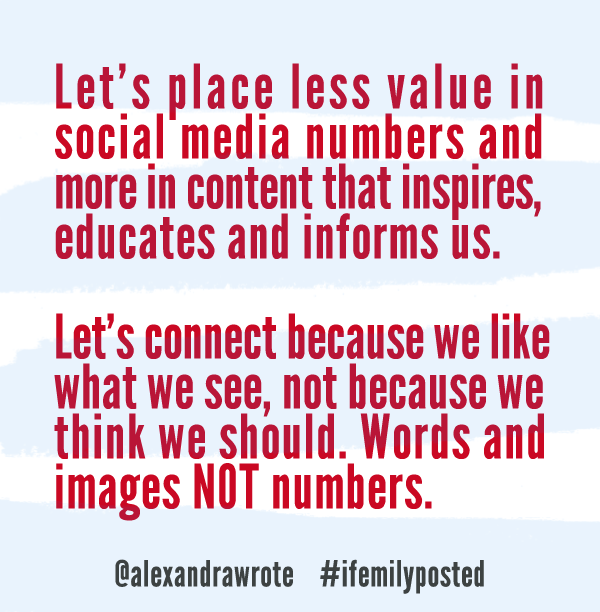
Let’s place less value in social media numbers and more in content that inspires, educates and informs us. Let’s connect because we like what we see, not because we’re think we should based on numeric value.

If StatusPeople’s Fakers app is the beginning of a shift toward transparency in social media, let’s find the silver lining here. There is a tremendous amount of talent online. If we, as bloggers, continue to produce the best work we can, than the opportunities that blogging brings will remain possible, regardless of the social media number du jour.
If Emily Posted: The Who

I’m honored that I’ve been asked to speak on a panel about social media at BlogHer ’12. I believe that the ways in which we share online are wonderful opportunities to inspire and be inspired. I also believe that embracing the new means we can’t disregard the past. The new ways we share ideas don’t mean we change the way we respect them.

I recently wrote a piece for BlogHer about the early days of filmmaking, about films like Hugo and The Artist, and how they touch me on a personal level. My family has been making movies for over 100 years.

My great grandfather was a producer who made the transition from silents to talkies. My grandfather is a writer, producer and director who began in film and became a television pioneer. My grandmothers are actresses who made the same transitions from stage and film and radio to television.

I didn’t witness those changes firsthand, but I learned from them.

Some of my earliest memories are of my father’s cutting room, playing with film cores and napping in trim bins. These things disappeared as film moved to digital, and he no longer held in his hands the film that he cut.

I witnessed those changes firsthand, and I learned from them.

I began writing online content over a decade ago. I was in college when I was hired by AOL and for several years delivered articles every Friday via dial-up. I kept writing screenplays and worked with private clients doing editing or research. I then joined the staff of a film magazine and later was editing there. While my passion for print and screenwriting hasn’t waned, I’ve found my place online more than print the last few years.

But I didn’t begin blogging until a year ago. I blogged vicariously on the sites of others for years by guest posting, as I began to find myself excited and fascinated by what was being written online. As a photographer, I went from film to digital - I took that work online as well.

When I began blogging, greatly influenced by my two friends Morgan (who I met when I was really little) and Eden (who I met via the Shrinky Dink effects of the blogosphere), I found so much of what applied in my offline work disregarded online. And not in a progressive way. Not in a way that was revolutionizing anything.

I think there’s a pattern in all of this. A pattern that explains why If Emily Posted is so important to me. I have read, watched, and learned firsthand about how entertainment and information is shared. How with every technological advance, there were those left behind. Those who couldn’t or wouldn’t see the value or maybe were too afraid of change.

I come from a long line of artists and innovators who have always stressed the importance of embracing the new but who believed that with a connection to the past, to the ways things used to be done, we’re better at what we do in a brave new world.

And I think that’s why I am unwilling to listen to the comments, the posts and tweets that say people have to realize this is the future. That the way people misbehave online isn’t something to change or simply accept, but something to embrace.

As a writer and photographer, I have had firsthand experience with my work being misused and abused - that’s personal. I’ve watched it happen to friends and colleagues. That feels a bit personal, too.

I was raised with a real appreciation of how the past is applied to the present. How we need the one to succeed with the other.

And that’s why I’m here. That’s why all of this matters to me.

In the last week, we saw a examples of how viral messages are spread so quickly. How often people take info and pass it on without doing any homework, as Jessica wrote about so poignantly.

I’m not comparing a social media style guide to labor practices in China or atrocities in Uganda. But I do believe that it’s important that when you take information from online sources, like this blog, you know where the opinions and ideas are coming from (this applies in print, too).

All week I’ll be writing about the who, what, when, where, why and how of IEP.

I was thinking about a linkup for Friday. I want you to share how you’re feeling. To say what you love, hate, hope you’re doing as a blogger. How the internet enriches your life, the moments you’ve wanted to walk away, the moments you’ve realized why it mattered to you.

I’m not sure if people will be interested. Drop me an email at alexandrawrote [at] gmail or leave a comment and let me know if the linkup is something you’d be into. It’s not about preaching but rather putting it down on paper why this place matters and how you want to be respected.