Accountability. Responsibility. Integrity. Why yes, this is a bit like the ABC After School Special edition of If Emily Posted.
FACT: Copyright online is copyright offline. Content creators own their work unless stated otherwise. It is their call as to who, what, when, where, why and how their work is reproduced.
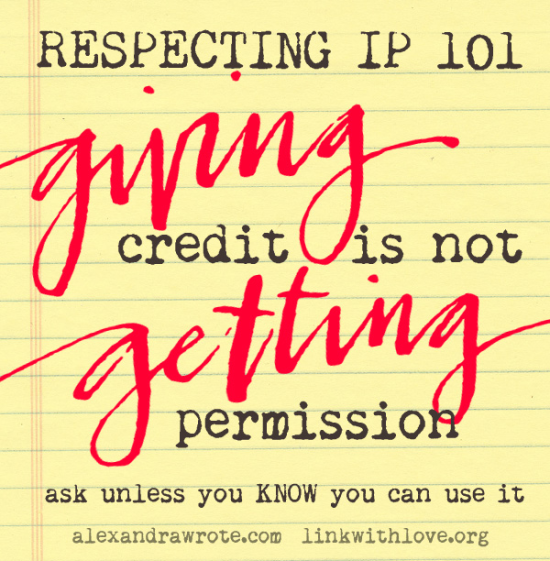
Forgive the screeching vinyl of this broken record, but I urge everyone to write it on their heart, or a Sharpie on their hand, or a post it on their desktop: Giving credit isn’t getting permission.
 NOT A FACT: If you put it on the internet you should expect people to take it.
If there weren’t laws that said something to the contrary, I’d say that this was simply my opinion. But it’s not. It’s the law. You should not expect things to be taken. The world can’t function that way.
Here’s my concern. I watch as bloggers work hard to create clever, engaging, informative content. I also watch as marketers and social media gurus teach people how to build their audience, reminding them that they need to be placing content on all platforms, all the time. Posting and pinning and updating with new visuals that create conversations on their Facebook Pages or gather Pinterest followers, and ultimately, lead to click throughs to their sites.
Who are people willing to hurt to get those clicks? Who are you willing to hurt by sharing content you don’t have the right to use?
We need a Slow Internet Movement. We need to slow down the speed at which we are sharing. If we aren’t considering who we might be hurting for the sake of a few clicks, this blogosphere is going to fold in on itself. We need new content and new ideas in order to grow. And yes, those take a bit of time to create.
I was talking to Charlie and Andy, the duo over at How To Be A Dad. They’ve been dealing with a lot of IP theft this week. They work hard to create their content. High quality, witty and smart stuff. And you may have seen it, even if you’ve never heard of their site. Because you could like a TV show like GUYS WITH KIDS, who posted one of Charlie and Andy’s pieces on their Facebook Page sans attribution. (They have since added a link, but that’s beside the point really. See that whole credit isn’t permission business.) Or you’ve been to NickMom.com, where both they and Type-A Mom, Kelby Carr, have been dealing with what I can only describe as content integrity issues. In the case of Charlie and Andy, NickMom.com has a cartoon that is incredibly similar to one of their own. With Kelby, they’re using her very widely known brand in a parody. Amy writes more about it, here. (I’ve reached out to NickMom.com for their side. I’ve yet to hear back, but will let you know.)
As Charlie says, “We rely on sharing and attribution to build our audience and social following. It’s the only way that we have a chance in hell to possibly eek out a living doing what we love. Sites like failblog, funnyjunk and others slap their own logo on the bottom of a photo or infographic, often covering up an author’s signature. That’s tantamount to taking a painting and slapping a sticker on the the artist’s name. Why shouldn’t an author or creative get credit?”
When I wrote about Why Every Social Media Manager Should Be Good. Period., it meant that searching an image for an original source should be a given before placing it on a social sharing site. It takes seconds to do. When creating content, all sites, but especially those connected to brands, need to do their homework. Charlie and Andy would have been happy to work with NickMom.com. They have the same audience. It would have been a great business move for both of them. NickMom.com is seeing now that it is far better to engage rather than enrage your audience.
RULE: If you aren’t creating original content, you must ask permission before using someone else’s.
I saw this on Charlie and Andy’s Facebook Page.
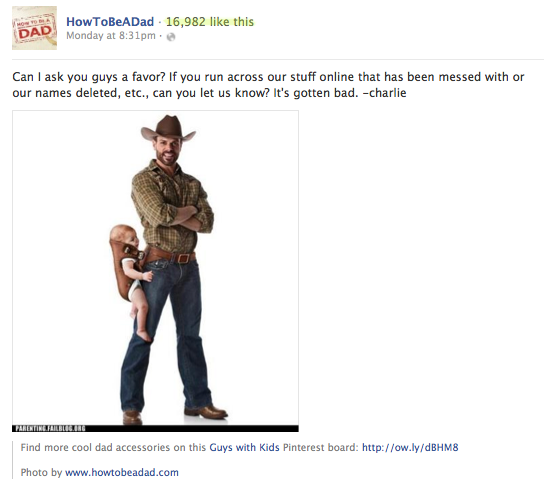 Look at how many LIKES this post got. This cyber village has its own neighborhood watch. I can’t tell you how many the people have told me they learned about the misuse of their content not via Google Alerts or searching but because someone else told them.
This community can only succeed when we stand together and call out this behavior. People work hard to create their content. And unless we put the brakes on here, people will not stop stealing. Because the business model is now one that says you can only succeed if you keep feeding the beast, and yet, it’s one impossible to satisfy. No one is capable of moving at the speed of social media. This model is broken.
Imitation as flattery no longer applies in the 21st century. Imitation has become a desperate attempt to keep up. And at what cost?
We need to slow down.