Tag Archives: look for the silver lining

If Emily Posted: Safety Pins

The conversations about whether Pinterest is acting as pusher in a sea of potential copyright infringement issues have been incredible. For the most part it assures me of what I truly believe: people don’t set out to do the wrong thing, and most, upon learning they are, want to know what they can do to fix it.

I am writing this at the same time many others are asking similar questions, and in the last several days, Pinterest offered some additions to their site, like coding to add to make your site un-pinnable. For some, I think this is a great thing. But those who like Pinterest and want to be able to share our original content with permission, we need other options.

For now, a SAFETY PIN seems as good a solution as any.
don't save this one - it's going to send a double message

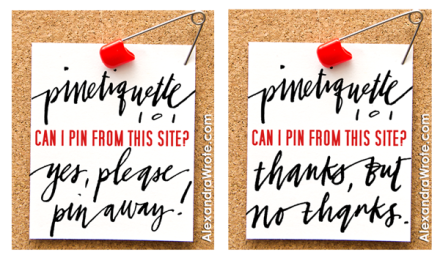
Since most people can install a widget, it doesn’t require coding that must be added to every page of one’s site. Simply choose the one that fits your needs at the bottom of the post and place it somewhere highly visible on your sidebar. While it doesn’t guarantee that people will honor the “thanks but no thanks” option, I think that it’s a start. (To add a SAFETY PIN to your site, simply click one of the images at the end of the post and save. I don’t know if I’ll ever say that again. But please, right click and save this one.)

The battle that is being waged about copyright and credits on Pinterest is complicated. While I believe in the importance of copyright and defend it, I am all for the ability to share and learn from one another online.

Sharing isn’t stealing. The two are not mutually exclusive. And proper credit is crucial to keep one from becoming the other.

I’ve had my work misused because it wasn’t properly credited. Copyright issues aside, what I found must unsettling with each situation was the lack of attribution. In one instance, after a photo of mine was published without consent, the publishers were quick to remind me it would bring me exposure. I had to remind them that if they googled the name credited, no one would find me. If the person who had taken my work and used it had at least credited my name properly I could have seen a silver lining in it. But improper credit = no exposure. Lose, lose.

I read comments on various posts written about the issues of copyright and credit online. When people, many sharing the surname Anonymous, write that you shouldn’t be online if you don’t want your work seen, I worry. Not so much about the work, but about the misinformation these Anons perpetuate.

In the last decades we’ve watched digital replace analog. The days of mix tapes are over. And so are the bad quality of a fourth generation copy of a movie. Piracy is crisp and clear on CD and DVD.

Still, the film and music industry continue to create and sell their work. And people buy it.

So, please do not tell me I don’t get it. There are plenty of people happy to play by the rules.

I am all for sharing. That’s what we do online all the time. But what I share and what someone does with what I share are two different things.

From country to country copyright issues vary, the idea of Fair Use is defined differently - these legal issues cannot be answered simply and tied up in a pretty box with a bow. But the issue of giving proper credit is simplistic in comparison. Use what you have permission to use, and make sure anything to share is credited to the original source. If you don’t have those things, bookmark it the old fashioned way. xo a.

A quick question: When you see corporations and companies creating Pinterest boards featuring their content, do you think that mans they’re telling us we can repin with their permission? I’m looking into it with several brands now but just thought I’d ask your POV.
five great things someone else said, vol. 31

Growing up in LA, we had great public libraries, but I imagine some had librarians who were a bit more excited about their work than mine. In my memory, inquiries more akin to talking to Nick Burns, the computer guy Jimmy Fallon played on SNL, than someone who was eager to share their love of books.

I’d visited that branch for close to a decade when one day, when I was about sixteen, I found myself wandering in circles. The card catalogs had moved. The library wasn’t large, but I went between rooms repeatedly, thinking I had missed them. As though massive blocks of wood were so easy to miss.

I finally asked and a finger was pointed in the direction of a waist-high table about eight feet long. On it sat a row of computers. Aesthetically, it was just awful. PCs circa 1994 were a drab Band-Aid beige. The card catalogs were a rich, honey-colored wood with brass pulls worn with age. On the computer I found what I wanted, but I missed the catalogs. Amongst those cards I’d always found what I wanted, but I’d also happen upon the unexpected. It’s the same sort of thing that I miss when shopping online, too – be it for books or clothes - a chance encounter with something you never knew you always wanted.

Searching through shelves for Rilke you might find a book of Rumi‘s poetry absently left on the ledge. Browsing for a little black dress and finding a faux fur vest with a silk peacock feather lining left when someone lazily changed their mind. The book, the coat - things unexpectedly fabulous.

I love the unexpectedly fabulous.

Card catalogs weren’t always an adventure, but they held the possibility. Even before I understood the Dewey Decimal System, I loved the clickety-clack of flipping through rows of yellowing, hand-typed index cards. Each and every one taken for granted until the day I couldn’t find them anymore.

I can almost equally divide the years of my life I’ve spent tethered to technology to those I have not. So many moments like the day the card catalogs disappeared. Days inextricably linked to the internet, like the day River Phoenix died.

It’s so easy, too easy, to romanticize the past. I believe that once upon a time things were both wonderful and awful. Things were often more complicated and far less so.

These days, I find a lot of book chatter online. People ask for recommendations or share their favorites not just on bibliophile sites like Good Reads, but on Facebook and twitter, too. A friend is starting a book club via her blog.

Last week, I found myself in a comment thread on Instagram discussing books that we adore because someone posted the cover of a novel they were reading. A discussion about a book, of bound and printed paper, photographed using a cell phone and posted on the internet. It made me ridiculously happy. Happy to see this fusion of the old and new. Of life before and after.

The unexpected fabulousness found on a random bookshelf now found in a random Instagram. The same, only different. xo a.

And now five great things someone else said about change:

Life is a series of natural and spontaneous changes. Don’t resist them; that only creates sorrow. Let reality be reality. - Lao Tzu

When people are ready to, they change. They never do it before then, and sometimes they die before they get around to it. You can’t make them change if they don’t want to, just like when they do want to, you can’t stop them. - Andy Warhol, Andy Warhol: In His Own Words

Pessimists are usually right and optimists are usually wrong but all the great changes have been accomplished by optimists. - Thomas L. Friedman

New and stirring things are belittled because if they are not belittled the humiliating question arises ‘Why then are you not taking part in them?’ - H.G. Wells

If you don’t change your beliefs, your life will be like this forever. Is that good news? - W. Somerset Maugham

Also, library talk reminded me of a film I saw about a year after those card catalogs disappeared, Party Girl. When I went to look for a clip, I happened to read: “On June 3, 1995, it became the first feature film to be shown in its entirety on the Internet…”

A movie about a party girl turned Dewey Decimal devotee was an internet first. Only connect…