
 I’m thrilled to introduce the first guest contributor to If Emily Posted, Tracy, founder of Liberating Working Moms. I met Tracy as a fellow writer at BlogHer, and I appreciate both her take on social media manners and her shared loved of the written word, Oxford commas and all. I hope that in sharing her experience, she’ll help others to remember that their words and their work have value. As bloggers, it’s easy to be dismissive of one’s own worth. To worry you’re “making a big deal” when someone takes your images or content and to just “let it go.” Ultimately, it’s up to you to decide how you’ll react, but always know that your work and your site, no matter the size, matter. Your rights matter. - Alex.
Since becoming a blogger, I’ve heard gobs of stories from others about content being stolen, from posts to even pictures of children, as individuals set up blogs passing other people’s lives as their own. I never thought it would happen to me. These were huge bloggers, and I’m just a year into running Liberating Working Moms. However, a couple weeks ago, as I was checking my dashboard, I was notified of a blog linking to LWM. Generally, notifications like these make me happy to have others taking notice and giving shout outs to what we are doing, however, once I went to the site, I was mortified. Not only had they stolen one my of posts, word for word, picture for picture, but they had the audacity to put a link at the bottom of the post saying that readers could click over to LWM to check out the original post.
Of course I set off to twitter, where I knew someone out there had to know what to do to get my content removed. Two people who were quick in responding to my panic were Alex and Eileen. Eileen directed me to a post of hers that was syndicated on BlogHer on how to get stolen content removed, which gives step by step directions on how to go through the proper channels to file a grievance with the blog. This post of her stemmed from her own content being stolen. As well, just like she realized that the blog that stole her content was a scraping blog site, I found myself realizing that the blog that stole my content was doing the same thing. Each and every post on the perpetrating site was stealing material from all over the web.
Blog scraping is when someone sets up a blog and utilizes software to scour the internet for certain types of posts, and then the software automatically “scrapes” the content and posts it onto their blog. The blog that stole my material was a site scraping healthy recipes. I found it ironic that the post of mine that was scraped was a recipe post, where I link to someone else’s recipe, citing correctly with appropriate links.
After realizing this, I began the step by step process Eileen mentioned in her post. She even provides downloadable letter templates with great legalese to work with either a US host or a EU host within her post. Alex then chimed in, finding a contact page for the blog’s admin. Before going through the process of contacting the blog’s host, who I found out was in Singapore, I decided to email the admin, though I knew in my gut I probably wouldn’t hear anything back knowing what they set this blog up for, and really believing that the email was a fraud as well. After not hearing back from them, I sent a letter to the host two different ways. One was by creating a ticket via their contact form on their site, and the other was sending a letter directly to an email address on the host’s site. Several hours later, I noticed the site was down, I rejoiced, and thought all was good. But I was wrong.
I got a response from the ticket I created saying that the site was down. They wanted me to verify it. As I checked, I told them the site was down earlier, but was now back up, still with my post. Then they wanted verification and emailed links to my post and the stolen content post, as well as threatening legal action if they did not facilitate getting this blog to take down my material. (I had said this in the email to the blog admin, but remember they weren’t responding.) You see, hosts have to uphold laws that were placed to protect content online. In Eileen’s post on getting stolen content removed, she wrote:
(For) more information on the United States’ Digital Millennium Copyright Act or DMCA or the European Union’s Electronic Commerce Directive you can go to the following links: DMCA or ECD
While I was waiting to hear a response, I began going through the scraping blog, clicking on all the links of the other stolen posts, because remember this blog links back to the original post, and I began emailing the other bloggers with stolen content. Some blogs were small and some were huge nationally known institutions. I ended each email with, “Let’s get this scraping blog taken down!” Several people responded, grateful that I notified them of what was going on.
In the meantime, I was notified that the scraping site was suspended. The email said (remember they are writing me from Singapore):
Our side, we are getting the user to meet us online. So when I unsuspended the site. The user will go in and delete the content.
Great. But what about the other stolen content? Within a day, I was notified that the user responded and took down my content. I wasn’t happy with this outcome when I realized that even though my content was removed, the blog was still up. It was like the host was supporting blog scraping. I emailed back, explaining to them what this blog was doing, and they quickly responded that they would inform the user to take the site down. Two days later, the host emailed me once again saying the blog was down and to verify it. And surely it was! This all happened two weeks ago, and as I’m typing this up, I went to check to make sure it was still down, and it is.
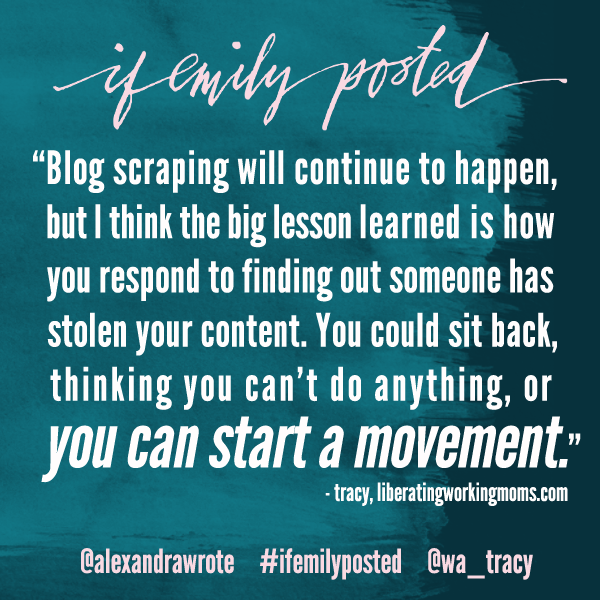
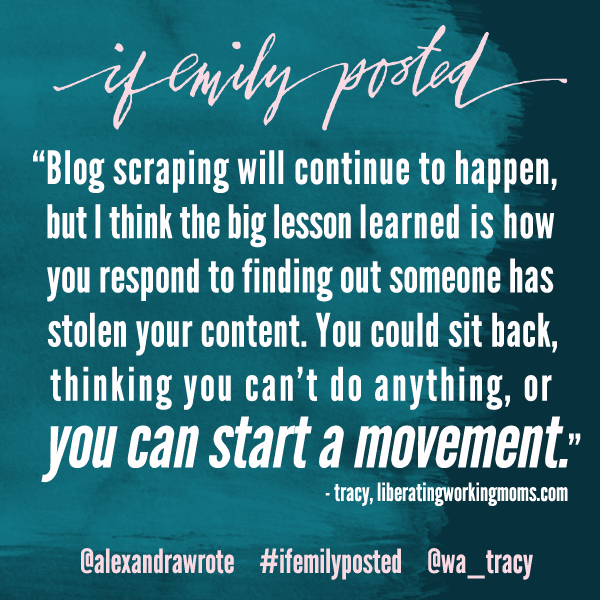
I have to say I wouldn’t have been able to get this scraping blog down if it wasn’t for Alex and Eileen. They helped me to feel like an empowered blogger. But as much celebration as I’ve had over achieving such great feats, in the back of my head I know that this is still going on to so many bloggers, big and small. Blog scraping will continue to happen, but I think the big lesson learned is how you respond to finding out someone has stolen your content. You could sit back, thinking you can’t do anything, or you can start a movement.
In doing some research I did find a site that has copious tips on how to outsmart the blog scraper. From HyperArts Blog they wrote The Definitive Guide to Blog Scraping & How To Stop It! I urge you to check it out and arm yourself to let blog scrapers know they can no longer get away with this behavior.
ABOUT TRACY: Tracy is a working teacher momma to a fun spirited, almost three year old girl. Just a year ago, Tracy launched the blog Liberating Working Moms, where she manages seven writers contributing their own journey’s as working moms on topics from breast feeding to childcare to finding balance and feeling guilt. In addition, Tracy is also a freelance writer working with ParentMap and BlogHer Entertainment. You can find her sharing 140 characters as @wa_tracy and @LiberatingWM.
